
Inside JJ Tyson’s Rise: Building a Modern Rock Empire Without Industry Limits

In a cultural economy engineered for immediacy, where visibility is often mistaken for value, JJ Tyson occupies a markedly different lane. His career does not hinge on reinvention as a survival tactic, nor does it rely on the cyclical rediscovery that sustains many legacy acts. Instead, it reflects a slower, more deliberate construct—one in which time has been used not as a constraint, but as a material.
More than four decades into his trajectory, Tyson’s current phase reads less like continuation and more like consolidation: an artist refining not only his sound, but the entire framework through which that sound is created and delivered.
Craft Before Currency
Tyson’s early years were not shaped by industry acceleration but by immersion. The local circuits of Pennsylvania offered neither scale nor spectacle, but they provided something more durable—repetition, discipline, and proximity to the mechanics of music itself.
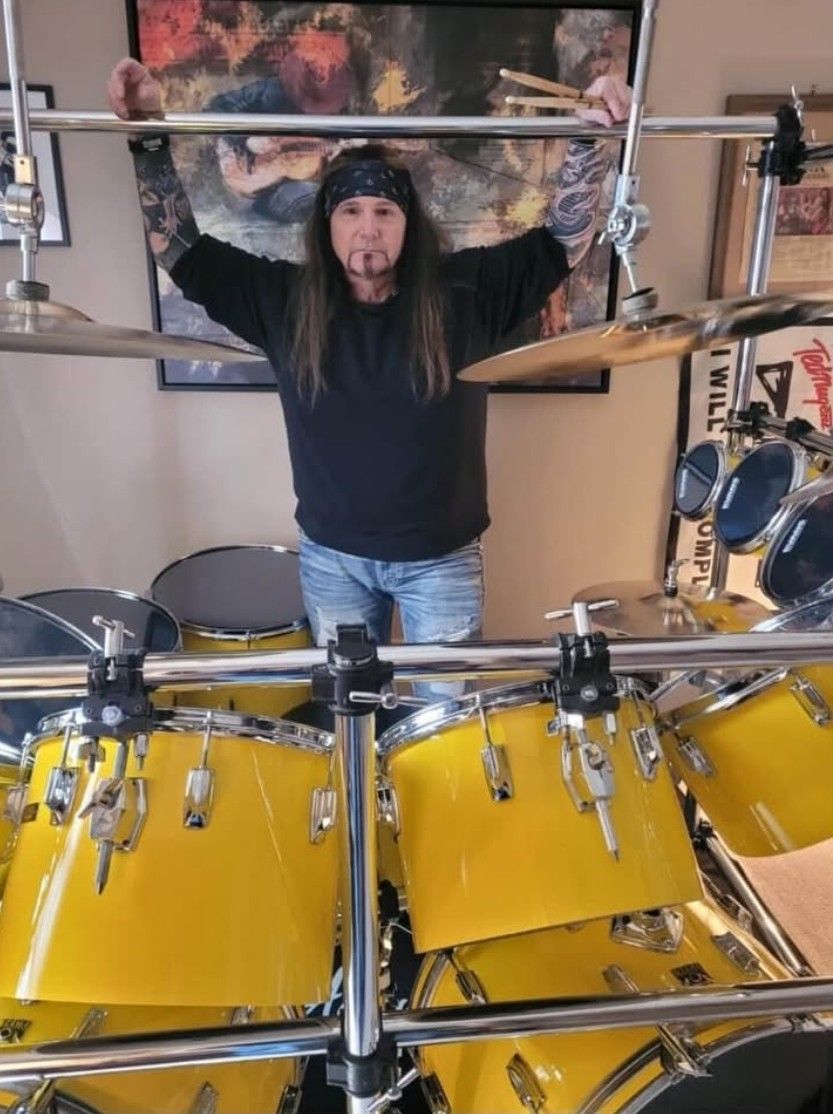
From that environment emerged not just a performer, but a builder. Drumming became composition; composition extended into production. Over time, Tyson’s role expanded laterally, giving him authorship over both the creative and technical dimensions of his work.
His collaboration with David Mobley—often framed as The Tyson-Mobley Project—can be understood as a period of calibration. It is here that Tyson’s instincts around structure, tone, and sonic layering were sharpened into something more intentional. By the time he moved decisively into solo output, the foundation had already been engineered.
A Catalog as Continuum
Rather than presenting as a sequence of stylistic departures, Tyson’s body of work functions as a continuum. Each release extends the logic of the previous one, even as it introduces new tonal or thematic elements.
From the density of Digital Mind Crime to the introspective textures of The Other Side Of Me, and the atmospheric weight of Cellar Dweller through to the spiritual undertones of Army Of Faith, there is a consistent sense of internal coherence. Genre, in this context, is not a boundary condition but a variable—something to be adjusted rather than adhered to.
Even his seasonal work does not disrupt this continuity; it integrates into it, reinforcing the idea that Tyson’s output is less about categorization and more about construction.
Recomposition as Method
With Journey To Nowhere, Tyson introduces a new structural layer—one that resists easy classification. The project’s defining characteristic lies in its synthesis: a convergence of southern narrative sensibilities with the density and force of heavy guitar arrangements.
This is not a superficial blending of styles, but a recomposition of them. The initial prompt—posed by Mobley as an exploration of country influences—serves merely as a point of departure. What follows is a reconfiguration, in which familiar elements are reorganized into a distinct sonic language Tyson identifies as Outlaw Southern Metal.
The inclusion of additional vocal collaborators contributes not to divergence, but to dimensionality, allowing the material to hold both texture and clarity without diluting its core identity.
Intent Over Visibility
The project’s lead single, For The Love Of Freedom, exemplifies Tyson’s broader orientation toward meaning. Its thematic focus—centered on service and sacrifice—does not lean on overt dramatization. Instead, it maintains a measured tone, allowing its subject matter to resonate without excess.
This restraint is indicative of a larger philosophy. Tyson’s work does not seek immediacy for its own sake; it privileges durability over reaction.
Trajectory Without Volatility
In recent years, Tyson’s profile has expanded across media platforms, yet this growth has occurred without the volatility typically associated with digital-era exposure. There are no abrupt inflection points, no singular viral catalysts—only a steady accumulation of presence.
Such progression suggests an alternative model of visibility: one grounded in continuity rather than disruption.

Autonomy as Framework
Central to Tyson’s current position is his independence. Absent the mediation of traditional label structures, his output remains internally consistent—free from external recalibration or imposed direction.
This autonomy is not merely logistical; it is conceptual. It allows for a unified vision in which production, release, and identity operate within the same system.
Forward Orientation
What distinguishes Tyson’s present moment is not its retrospective quality, but its forward orientation. With additional projects already in development, his trajectory resists the gravitational pull of legacy framing.
He is not curating a past.
He is extending a system.
A Different Measure of Time
JJ Tyson’s career invites a reconsideration of how artistic longevity is understood. Rather than diminishing creative capacity, time, in his case, has functioned as a refining force—compressing experience into clarity, and clarity into direction.
In an industry calibrated for speed, Tyson operates with deliberation.
And in that deliberation, he has found not limitation—but scale.